
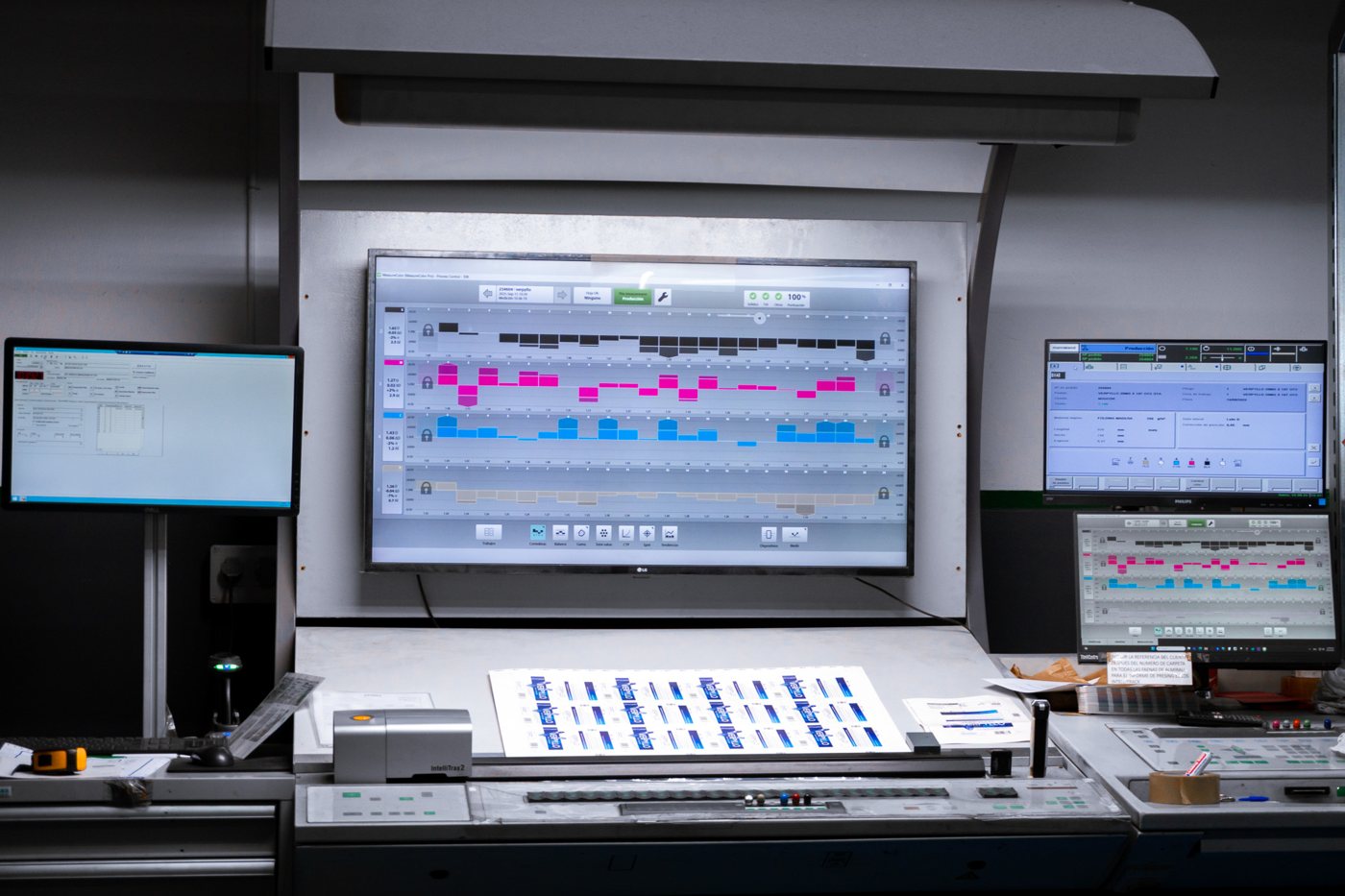
Most pressrooms still bring color in by hand: the operator reads a sheet, judges it against a proof, and turns the ink keys until it looks right. Closed-loop color control replaces that manual loop with a measured one that runs continuously, run after run.
What closed-loop color control actually is
Closed-loop is a continuous cycle of three actions: measure, decide, correct. A measurement device reads the color bar on the printed sheet, software compares each ink zone to the target, and the press ink keys are adjusted automatically to bring color back in line. Open-loop control, by contrast, depends on the operator to read and adjust by hand, which is slower and far less repeatable.
The three building blocks
Every closed-loop setup combines three parts, and most printers already own the first one.
- Sensor: a handheld spectrophotometer, an automated scanning table such as X-Rite IntelliTrax2, or a true inline system that reads color on the sheet.
- Decision layer: the software that holds your spectral targets and standards (ISO 12647, G7) and computes the correction.
- Actuator: the press ink-zone control that moves the keys. The approach is press-agnostic across Heidelberg, Koenig & Bauer, Komori and Manroland.
What it changes at makeready
CIP3/CIP4 presetting opens the ink keys from prepress data instead of from a default, so the press starts close to target. Closed-loop then drives it into tolerance in fewer pulls, which means fewer sheets and less ink burned before the first saleable copy.
What it changes during the run
Color drifts as paper batches change, fountain solution shifts, temperature rises and plates wear. A closed-loop system measures and corrects every few sheets, so color stays inside your DeltaE tolerance from the first sheet to the last, not only at occasional spot checks.
The outcomes you can measure
- Lower makeready waste and shorter setup time.
- Tighter DeltaE, held consistently across shifts and sites.
- Fewer reruns and customer rejections.
- Auditable color data for every job, useful for brand owners and packaging compliance.
How to get started
Most printers already own spectral measurement, handheld or scanning. Going closed-loop is the step of adding the decision and actuator layer, for example with Rutherford ColorLoop. A free console validation confirms whether your specific press console and ink-key system qualify, in about two minutes.