
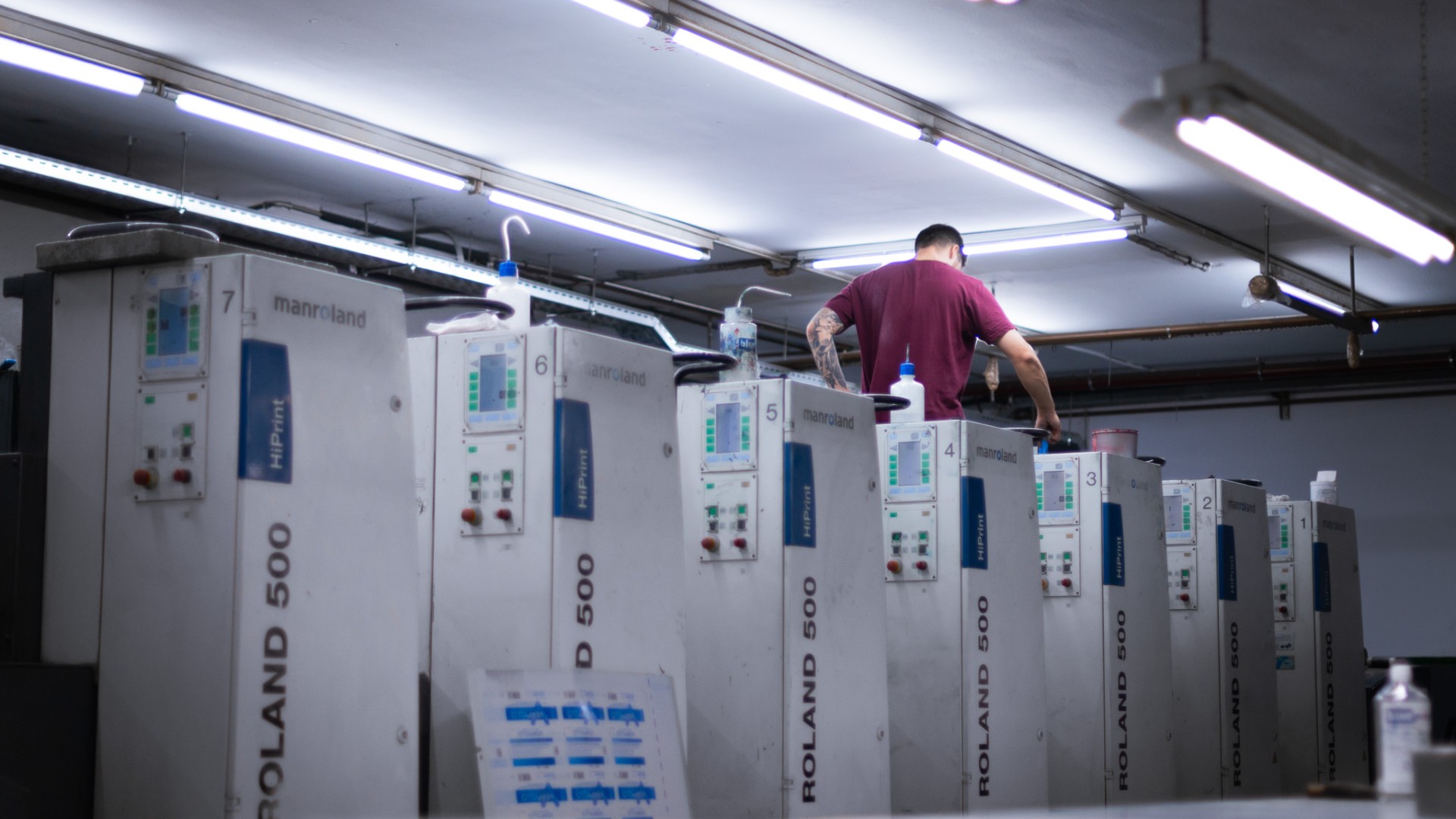
Makeready is where margin quietly leaks out: paper, ink, energy and press time, on every single job. The good news is that most of it is addressable with changes you can stage one at a time. Here are ten levers, with the highest-impact ones first.
Where makeready waste comes from
Waste at makeready is the spoilage between starting a job and the first saleable sheet: bringing register, ink density and color to target by hand. The longer that takes, the more paper and ink you burn, and the less press time you have for billable work.
The ten levers
- CIP3/CIP4 ink presetting: open the ink keys from prepress data instead of from a default.
- Closed-loop color control: measure and correct automatically until color is in tolerance.
- Standardized substrates and inks, printed to ISO 12647 aim values.
- Plate and register presetting, with automatic plate loading where available.
- A spectral color bar on every sheet, tied to a defined target.
- Shared operator procedures and training, so every shift makes ready the same way.
- Fountain solution and ink temperature control to keep the process stable.
- Clean prepress: correct ICC profiles and reliable soft-proofing.
- Job batching by substrate and color to cut the number of changeovers.
- Measuring waste per job, so you have a baseline and a KPI to improve against.
How to measure the savings
Track four numbers per job: sheets to the first OK sheet, DeltaE on that first sheet, makeready time, and ink and paper consumed before approval. Improving the first two almost always pulls the other two down with them.
Where to start
Most printers already own a measurement device. The fastest gains usually come from pairing CIP3/CIP4 presetting with closed-loop control: the press starts close to target, then reaches it in fewer pulls. A free console validation confirms whether your console qualifies.