
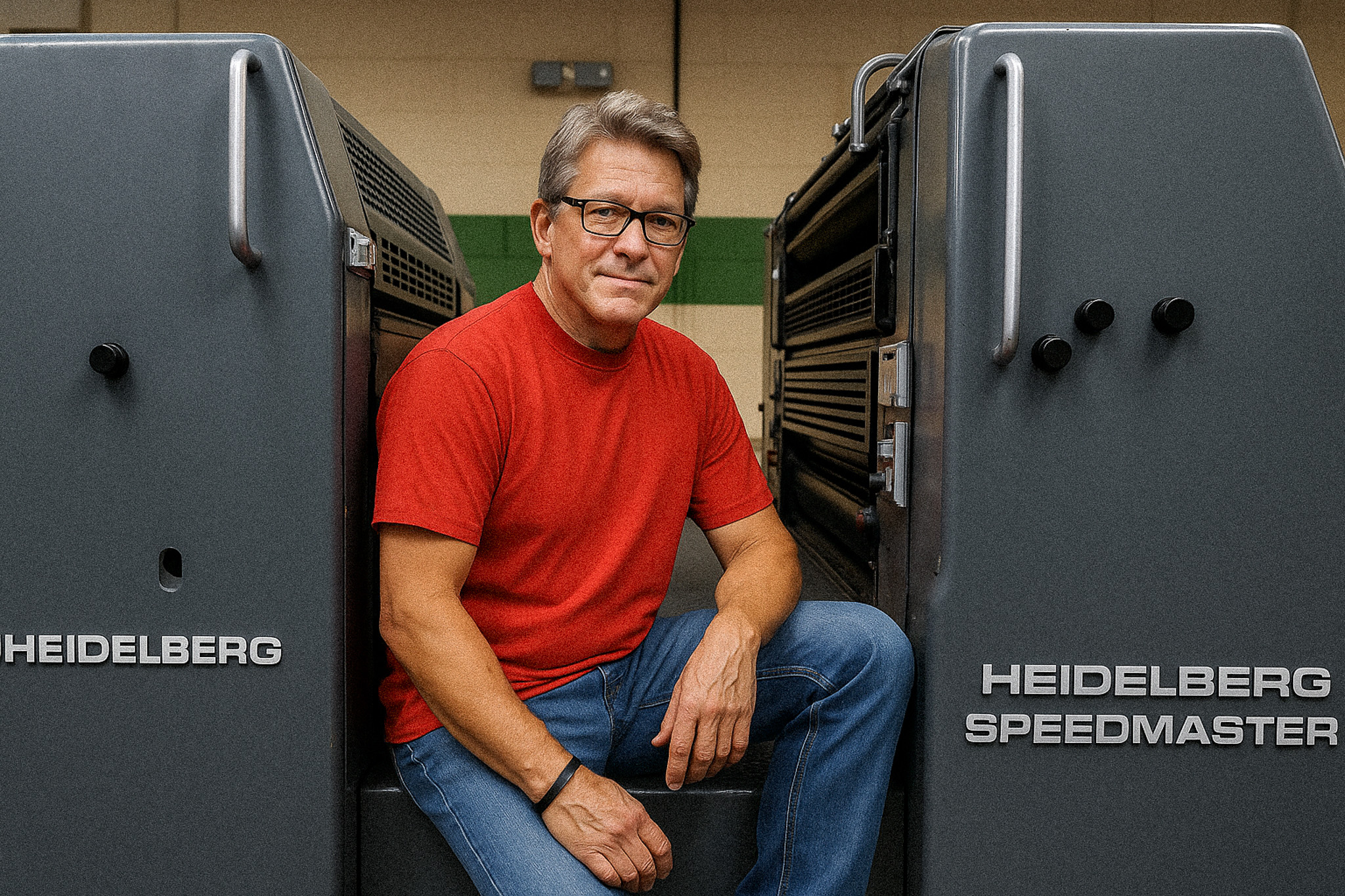
Vogel Druck, part of Bertelsmann Marketing Services, will wind down its Höchberg site near Würzburg by 30 June 2027. The reason given by the company was not a bad quarter but a structural one: demand from publishers and retailers in web and sheetfed offset has been declining for years, the site has been loss making, and no recovery is expected. 280 jobs go with it.
That closure is one point on a long line. European publication gravure has shrunk to roughly 48 presses after the Prinovis Ahrensburg shutdown, down about 30 percent against 2021 and more than 60 percent against 2015. Retail catalogs went digital, and the tonnage went with them.
Capital has not left print, though. Koenig & Bauer opened 2026 with order intake of 297.6 million euros, up 21.4 percent and its strongest first quarter in two years, with paper and packaging sheetfed systems up 12.4 percent. Presses are still being bought. They are being bought for packaging and for short run commercial work, not for 400,000 copy catalogs.
Why shorter runs raise makeready cost
Makeready waste is a fixed cost per job. Whether a job runs 3,000 sheets or 60,000, the press still needs plates hung, ink keys brought to target, and a set of sheets pulled and measured before the first good one comes off. Spread that fixed cost over fewer good sheets and the cost per thousand rises in a straight line.
A pressroom that used to average 25,000 sheets per job and now averages 10,000 has not lost 60 percent of its volume. It has multiplied its number of job changes by 2.5 for the same tonnage. Every one of those extra changes carries its own paper, ink, energy and press hours, and every one of them is an opportunity to end up outside tolerance.
- More job changes per shift for the same output
- A larger share of press hours spent producing nothing sellable
- More color approvals, so more chances to drift off standard
- Higher exposure to paper cost, because waste is bought at the same price as production
This is why the useful number in a consolidating market is cost per job change, not cost per thousand impressions. Two plants with the same press model and the same crew size can sit far apart on that number, and the gap never shows up in a capacity comparison.
How much does a makeready actually cost?
It depends on the press and the job, but the order of magnitude is stable: a manual color approach on a mid format sheetfed press typically burns several hundred sheets before the operator signs off, and each of those sheets carries the same paper, ink and energy cost as a sellable one. On a plant making twenty job changes a day, cutting 150 sheets per makeready is roughly 3,000 sheets a day, every day. The 2026 paper price increases make that arithmetic worse, not better.
The plants that keep the work
Brand owners and publishers are consolidating their supplier panels at the same time as printers consolidate their capacity. Fewer approved plants, more countries covered per plant, and a written expectation that the same job printed in two of them measures the same. That expectation now sits in contracts rather than in habits.
- Measured proof of color, job by job, not only a signed OK sheet
- The same tolerance applied in every plant of the group
- Fast requalification when a job moves from one site to another
- Data that still stands up in an audit six months after the run
None of that holds if color is still set by eye at each console. It requires the ink keys to be driven from measurement, on every job, in the loop.
Does closed loop color control still pay off on short runs?
Yes, and usually faster than on long runs. Closed loop delivers most of its value at the start of a job, when it brings the ink keys to target and holds them there. The more job changes a press makes in a week, the more times that return happens. In a short run mix it is the number of makereadies, not the tonnage, that drives the return on investment.
What does a press need before closed loop can be added?
An ink key interface the console will open, a measurement source on the sheet, and a press in reasonable mechanical condition. Age matters far less than most printers expect: systems run today on consoles two and three press generations old. A console eligibility check settles the question from a few photographs of the console and the machine plate, before anyone quotes anything.
Consolidation is regional, the standard is not
The same redistribution is under way outside Europe. North American commercial plants are merging while packaging capacity grows, Asian converters absorb work that used to be printed closer to the brand, and Latin American plants are being qualified for export packaging. What travels with the job is the standard, not the press. A converter serving a European brand from a plant in the United States is judged against the same numbers as the plant it replaced.
That is what a deployed base is for. Rutherford closed loop control runs on 1,000+ systems in 30+ countries, on presses of many brands and generations, which is what makes the same target reachable in Lyon, in Ohio and in Guangzhou, with the same ColorLoop logic at the console, fed by measurement from IntelliTrax2, MeasureColor or the device already on the floor. How the loop works end to end is set out in the complete guide to closed loop color control.
Capacity will keep leaving the segments that shrink. The plants that stay loaded will be the ones that can change jobs cheaply and prove their color while doing it. That is a production decision, and it can be made on the press already standing in the building.