
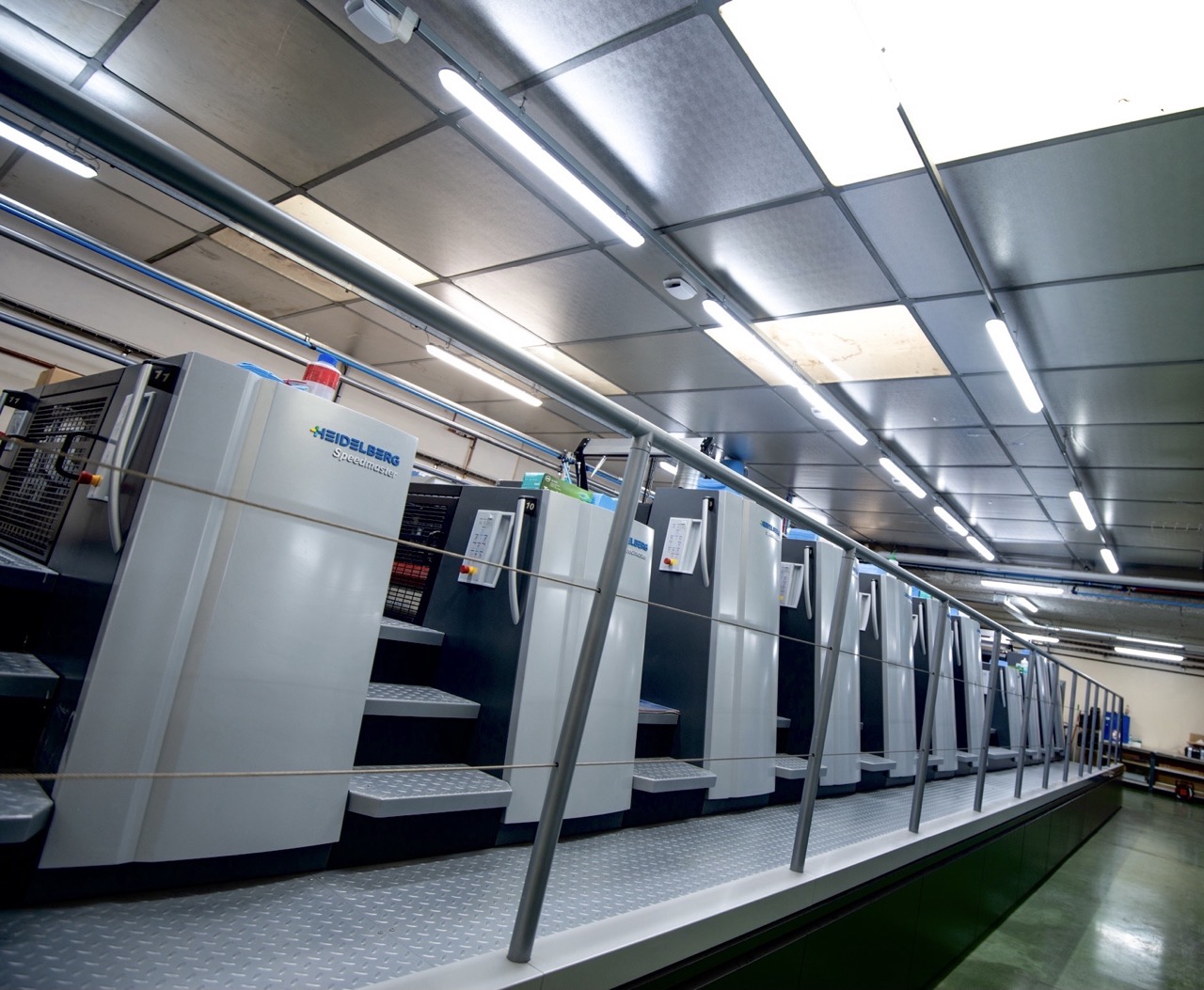
A European printer that wins work from a North American brand owner usually finds the same line in the print specification: G7 required, often with GRACoL 2013 as the reference. For a plant built around ISO 12647-2 and PSO, that reads like a change of doctrine. It is not. G7 calibration is a method for setting up a press, and it sits comfortably on top of the process control a European shop already runs. The real work lies elsewhere: holding the result through production, job after job, on presses that were calibrated once.
Why G7 calibration matters to European printers exporting to North America
G7 is the calibration method maintained by Idealliance, now part of PRINTING United Alliance, and it is the dominant reference in the North American print supply chain. Brand owners, packaging buyers and prepress houses in the United States and Canada build their files, proofs and approval routines around it. When they add a supplier in Europe, they do not rewrite that chain for one plant. They ask the plant to join it.
In practice the request arrives in three forms, sometimes all at once:
- A qualification requirement: the facility must hold a current G7 Master certification at a stated level.
- A print condition: files are separated and proofed to GRACoL 2013 (CRPC6) rather than to Fogra51 and PSO Coated v3.
- A reporting requirement: measured press sheets, or a conformance report, delivered with the job.
Do European printers need G7 if they already run ISO 12647-2?
Only when the customer asks for it, but export customers usually do. ISO 12647-2 and G7 are not competing standards: many shops calibrate with G7 and verify against ISO 12647-2 aim values, and one press can satisfy both. The comparison of G7 and ISO 12647 explains the difference in method, and what it changes for a pressroom that already controls tone value increase color by color.
What G7 asks of an offset press
ISO 12647-2 fixes numbers per color: the Lab values of the solids, the tone value increase curves, the tolerances. G7 starts from appearance. It defines a neutral print density curve and a gray balance relative to the substrate, so that two presses on different papers and different continents produce grays and tonality that look the same. The glossary entry for G7 gives the short version. The pressroom version is that gray balance becomes the thing you watch, because a gray with a cast shows a problem before any single solid drifts out of tolerance.
The G7 Master qualification has three tiers, each including the one before:
- G7 Grayscale: neutral gray balance and tonality, for work where no specific color space has to be matched.
- G7 Targeted: Grayscale, plus solid primaries and overprints that hit the Lab aims of a reference such as GRACoL 2013.
- G7 Colorspace: Targeted, plus a match to the whole reference print condition, the level required for contract proofing.
Which G7 level does an export customer usually expect?
Packaging and brand work rarely stops at Grayscale, because the brand owner wants the process colors, not only the grays, to land where the proof says. Targeted is the usual starting point for an offset supplier, Colorspace when the same plant also produces proofs. Qualification is carried out with a certified G7 Expert, the measured sheets are evaluated by an independent laboratory, and the certification is valid for one year.
GRACoL 2013 and Fogra51: close, not interchangeable
European printers sometimes assume that GRACoL 2013 and Fogra51 are the same premium coated condition under two names. They are close: both describe high quality coated stock, both are measured in M1 to account for optical brighteners, and both can be reached from ISO 12647-2 aims. But they are built from different characterization data, CGATS21-2 CRPC6 on one side and FOGRA51 on the other, and a contract proof made to one is not a proof of the other. The practical rule for an exporter is simple: separate, proof and measure against the dataset named in the customer specification, and attach that choice to the job, not to the press.
Calibration lasts a day, the certification lasts a year
This is where most export programs run into trouble. A G7 calibration is performed under controlled conditions: fresh plates, stable ink, the right paper, an expert watching the numbers. The certification then covers twelve months of real production, with different operators, different board lots, a fountain solution that warms up through the shift and ink zones that drift as the run goes on. A press that passed in March can be printing grays with a visible cast in June without anyone having touched a curve.
The buyer in North America never sees the calibration day. They see the pallets that arrive, and more and more often the measurement data that comes with them.
How do you keep G7 gray balance stable through a production run?
By measuring during the run and correcting the ink zones from the measurement, not from the operator's eye. A scanning spectrophotometer such as X-Rite IntelliTrax2 reads the color bar, MeasureColor compares it with the target, and ColorLoop sends the correction back to the ink keys on the console while the press runs. The target can be G7 and GRACoL 2013 for the export job and ISO 12647-2 for the next one, and the measurements stored along the way are the record you send with the delivery.
One plant, two references, the same loop
Few European exporters print only for North America. The same hall runs a job for a Paris brand to PSO in the morning and a job for a United States retailer to GRACoL in the afternoon, and a group with a converting plant in Canada wants both sites to look alike on the shelf. The pattern repeats worldwide: plants in Asia and Latin America supplying North American brands face the same double specification. What makes it manageable is not a second calibration team but a single control layer that switches target per job and holds whichever one is loaded, which is how the 1,000+ closed loop systems installed in more than 30 countries are used day to day.
G7 sets the destination. Closed loop control keeps the press on it for the whole year the certification covers. The complete guide to closed loop color control explains how measurement, comparison and correction work together on an existing press, whatever standard sits at the end of the loop.