
Komori confirmed in mid August 2026 that it is acquiring Maruyama Chiller Corporation, a Japanese manufacturer of temperature control units for semiconductor production equipment, in a deal valued at about 250 million dollars. The share transfer is expected to complete on 2 October 2026 and Maruyama becomes a wholly owned subsidiary. Nothing in that sentence is about printing.
It is not an isolated move. Heidelberg has built a second business around Amperfied charging stations, signed a partnership with PHENOGY on sodium ion energy storage, and set up ONBERG, a defense joint venture with Ondas. RMGT makes automotive components alongside presses. Among the large offset builders, Koenig and Bauer is close to the only one still concentrating on printing alone. The financial background is not hidden either: Heidelberg reported net sales of 404 million euros in the first quarter of its 2026/27 financial year, down 13.3 percent year on year, with an adjusted EBITDA margin of 0.2 percent against 4.4 percent a year earlier.
What OEM diversification means for an offset press retrofit
A press builder that finds growth in chillers, chargers or defense systems is not abandoning offset. Komori's press sales grew 2.5 percent in the quarter to June 2026, carried by sheetfed. But engineering attention, capital and product roadmaps follow revenue growth, and that has a predictable effect in the pressroom: the cadence of genuinely new offset platforms slows down while the installed base is asked to keep working.
Most European and North American pressrooms already run that way. A sheetfed press bought in 2012 is a mid life asset, not an old one, and it will print for another decade. The question stops being when to replace it and becomes what to add to it.
- Presses stay in production longer, so the gap between the newest machine in the hall and the oldest keeps widening.
- Consoles, ink zone electronics and measurement hardware age at a different speed from the printing units they sit next to.
- New requirements, PPWR documentation among them, arrive faster than press replacement cycles.
- Brand owners judge every plant against one color specification, whatever the age of the equipment behind it.
- Capital for a new press is harder to justify in a market where volume is flat and job length keeps falling.
Does a press builder moving into other markets make my press obsolete?
No. It makes the press a longer term asset than the purchase plan assumed. Parts, service and consumables continue, and offset remains profitable for the builders. What changes is where improvement comes from: less from the next machine generation, more from what you add to the machine you already run.
The upgrade that does not need a new press
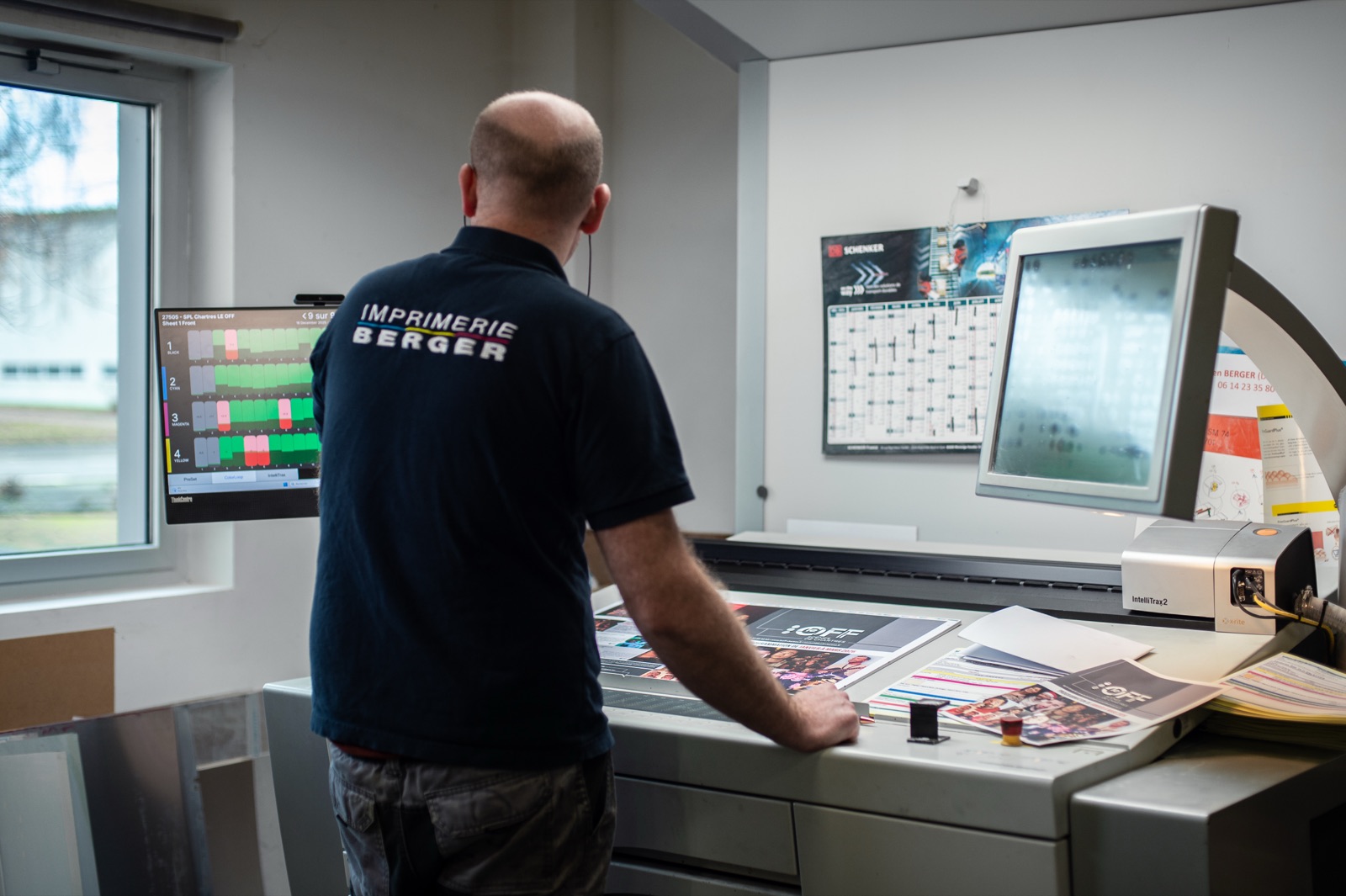
On an offset press, the last process still driven by human judgement at full speed is color. Ink presetting from CIP3 data gets the first sheets close, then an operator reads the sheet and moves the ink keys, and the accuracy of the run depends on how often that loop is repeated. Closed loop color control replaces the human half of it: the sheet is measured, the measurement is compared against the target, and the corrections go back to the ink zones automatically while the press runs.
That is a retrofit, not a machine. It connects to the console interface an existing press already has, takes its readings from a scanning spectrophotometer such as IntelliTrax2 or from MeasureColor, and leaves the printing units untouched. It is also why the same architecture runs on Heidelberg, Komori, Manroland, Koenig and Bauer and Mitsubishi presses of very different generations, in the 1,000 plus systems installed in more than 30 countries.
Can closed loop color control be added to an existing offset press?
In most cases yes. What decides it is the console, not the age of the press: the system needs a usable ink key interface, a measurement source and a mechanically sound ink train. Presses built from the mid 1990s onward are frequently eligible. What a console needs to be closed loop ready goes through the interfaces brand by brand, and a free console validation settles the question from a few photographs of your console and press plate.
Long life presses are a worldwide pattern
The consolidation is European, the installed base logic is not. Komori's own quarter shows how uneven the market is: sales in Europe up 40 percent, sales in the United States down 40 percent, over the same three months. Plants in North America, Asia and Latin America are making the same arbitration between a capital purchase and an upgrade to the presses already installed, and the brand owners buying from all of them apply one specification across every site.
That is the practical argument for standardising on a color control layer that is independent of press brand and press generation. When a group runs a 2008 press in one country and a 2024 press in another, the only way both hold the same DeltaE is for the same measurement and correction logic to sit on both.
How do I know a retrofit pays before committing to it?
Run the arithmetic on makeready waste, not on the price of the system. Count the sheets pulled before the first good sheet, multiply by the number of job changes in a month, then by the cost of the board. The ROI calculation does exactly that, and short run packaging work makes the multiplier larger every year.
The press you own is the one to improve
Press builders diversifying is a signal about their revenue mix, not a verdict on offset. It does tell printers where to look for the next productivity gain, and it is not in a catalogue of new machines. It is in the loop between the sheet and the ink keys on the presses already installed. The complete guide to closed loop color control sets out how that loop works, and Offset360 is the bundle that puts measurement, software and control together on an existing press.